

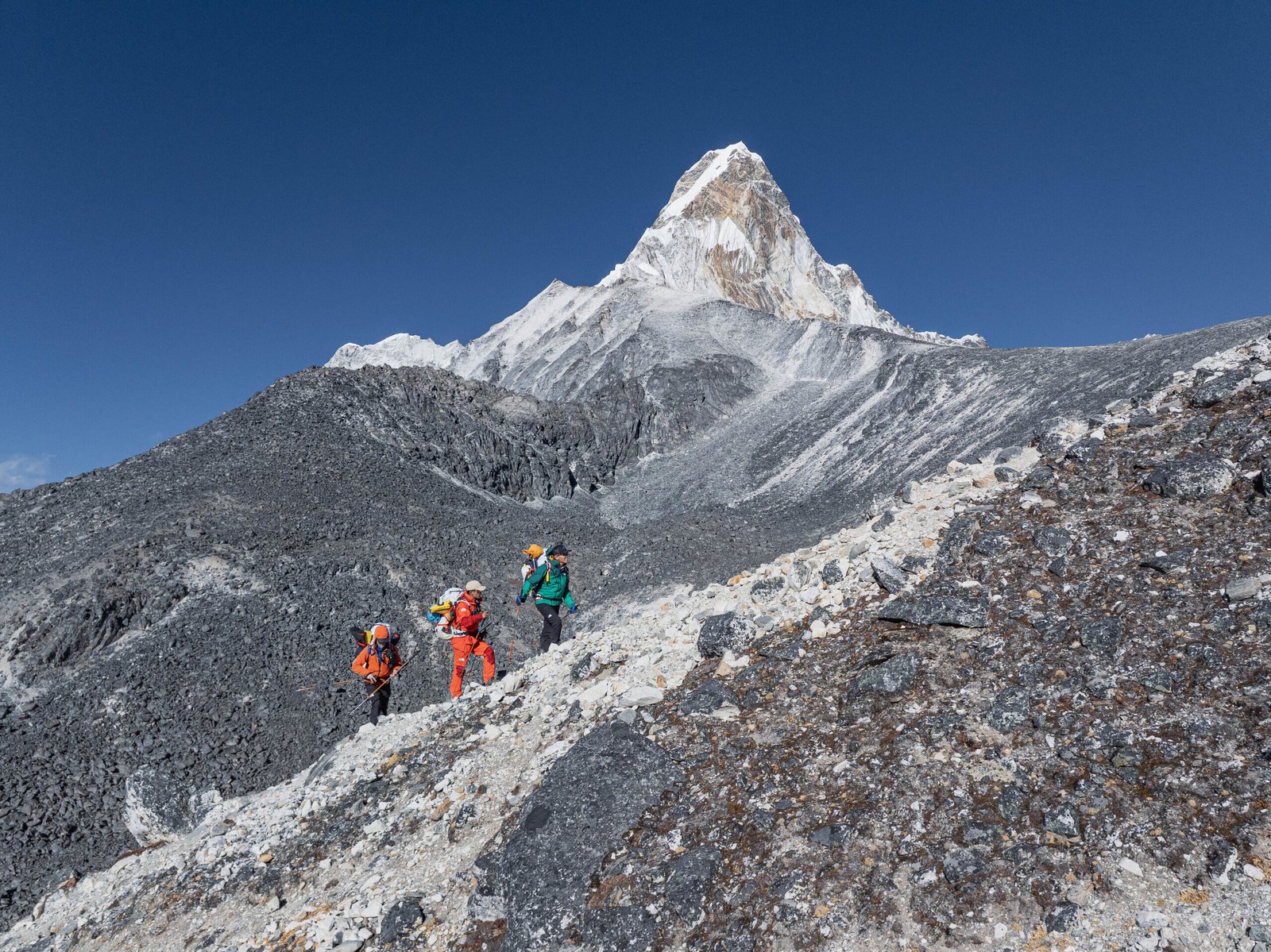
Rising dramatically above the Sherpa villages of the Khumbu, Mt. Ama Dablam stands at 6,812 meters and is one of Nepal’s most recognizable Himalayan peaks. Its distinctive pyramid shape, hanging glacier and exposed ridges make it visually striking from the Everest trekking route, but the mountain demands considerably more than physical endurance from those who attempt its summit.
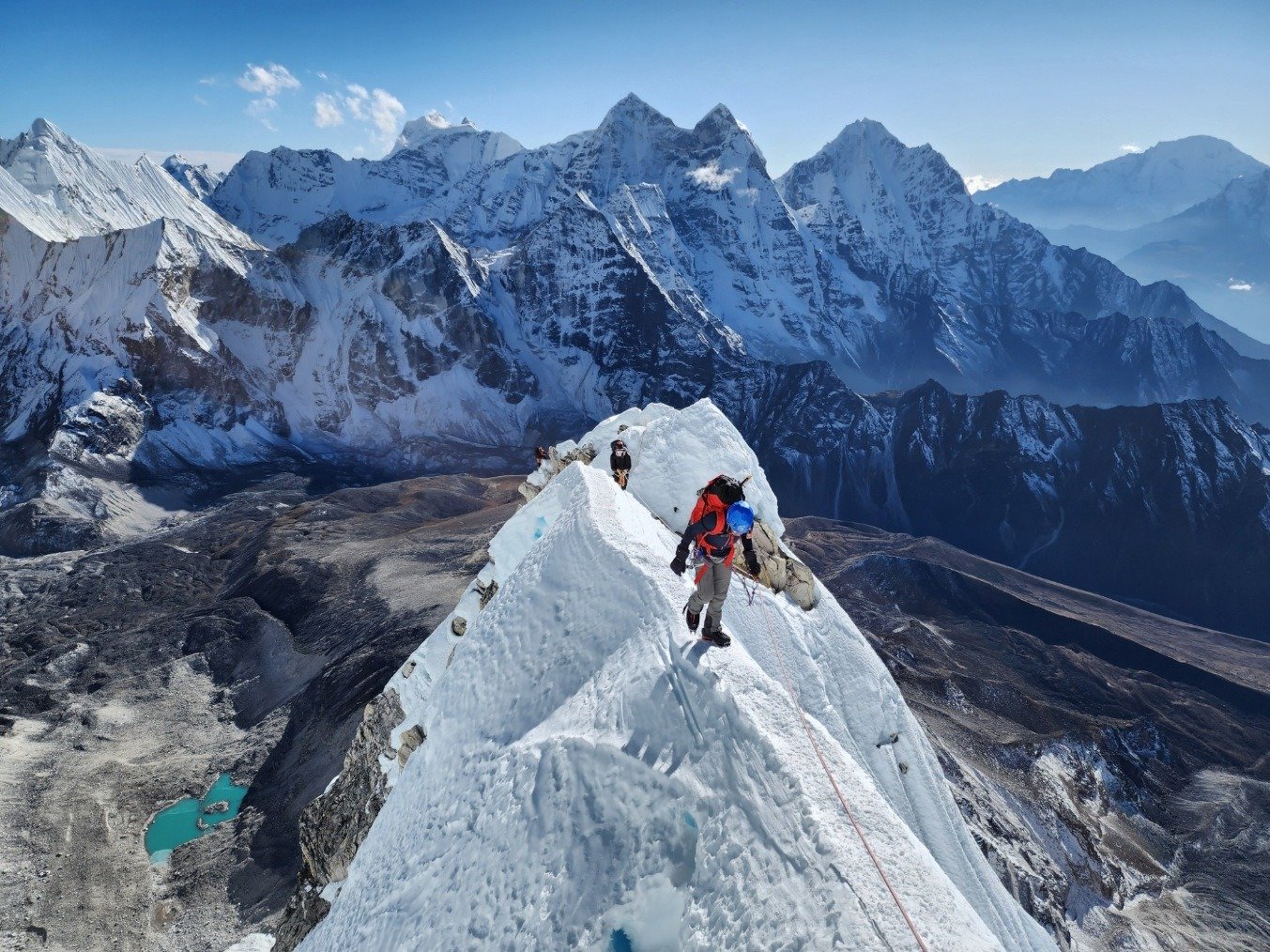
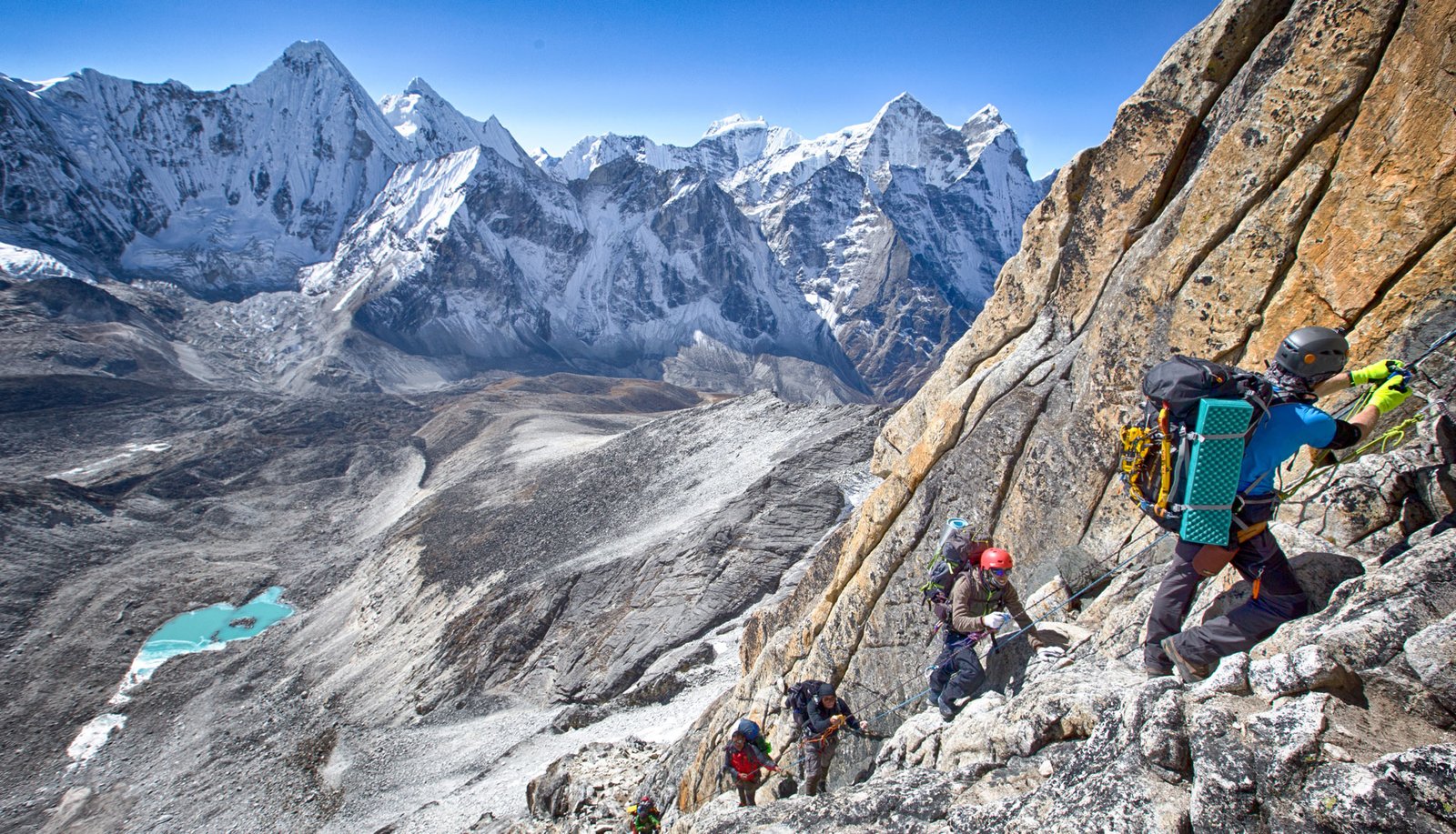
Above Base Camp, the character of the journey changes completely. The Southwest Ridge involves exposed scrambling and technical rock climbing before reaching the higher sections of the mountain. The famous Yellow Tower, narrow ridges, mixed terrain, steep snow and ice, and the exposed upper ridge make Ama Dablam a genuine mountaineering objective rather than a straightforward trekking peak.
The final ascent leads toward the upper mountain and the summit at 6,812 meters, where clear conditions can reveal an extraordinary Himalayan panorama including Everest, Lhotse, Nuptse, Makalu, Baruntse, Pumori and other peaks of the Khumbu. The climb requires careful acclimatization, strong technical ability, experienced climbing leadership and flexibility around weather and route conditions.
TrekUp Nepal’s Ama Dablam Expedition is designed for climbers looking to take on a serious Himalayan technical peak with organized logistics, experienced local climbing support, planned acclimatization and sufficient time for training, rotations and summit attempts.
Overview
The Mt. Ama Dablam Expedition is a demanding Himalayan climbing adventure to the 6,812-meter summit of Ama Dablam in Nepal’s Khumbu region. Following the classic Southwest Ridge, the expedition combines high-altitude trekking with exposed rock, snow and ice climbing, fixed-rope sections, technical camp rotations and a challenging summit push.
Highlights
- Summit Mt. Ama Dablam at 6,812 m.
- Climb the classic Southwest Ridge route.
- Experience technical rock, snow and ice climbing.
- Tackle the challenging Yellow Tower section.
- Complete high-altitude camp rotations.
- Acclimatize at Ama Dablam Base Camp.
- Experience Sherpa culture and Khumbu villages.
- Visit the historic Tengboche Monastery.
- Make a technical summit push at 6,812 m.
- Enjoy views of Everest, Lhotse, Nuptse, Makalu and Pumori.
- Experience a true high-altitude Himalayan expedition.
Mt. Ama Dablam Expedition Overview
The Mt. Ama Dablam Expedition is an ambitious Himalayan climbing journey to the summit of Ama Dablam (6,812 m), one of Nepal’s most distinctive and technically demanding mountains. Rising above the Khumbu Valley, Ama Dablam is renowned for its dramatic ridgelines, steep rock faces, exposed sections, and challenging high-altitude climbing. The expedition follows the classic Southwest Ridge, combining a scenic approach through the Everest region with progressive acclimatization and technical climbing at altitude.
The journey begins with the legendary trail toward the Khumbu, passing through Namche Bazaar, Tengboche, and Pangboche before reaching Ama Dablam Base Camp. From Base Camp, climbers prepare through technical training and acclimatization rotations, gradually moving toward the higher camps while becoming familiar with the rock, snow, ice, fixed ropes, and exposed terrain of the mountain. One of the major challenges is the Yellow Tower, a technical rock section encountered on the route toward the upper camps.
Reaching the summit requires more than physical endurance. Successful climbers need previous high-altitude experience, strong technical climbing skills, careful acclimatization, and the ability to make sound decisions in changing mountain conditions. With appropriate preparation and a suitable weather window, the final summit push leads to the 6,812 m summit of Ama Dablam, offering an exceptional perspective across Everest, Lhotse, Nuptse, Makalu, Pumori, and the surrounding Himalayan peaks.
TrekUp Nepal organizes the expedition around a structured approach, combining experienced mountain guides, acclimatization rotations, technical preparation, logistical support, and contingency planning. The result is not simply a summit attempt, but a complete Himalayan expedition designed for experienced climbers seeking one of Nepal’s most rewarding technical mountaineering objectives.
What can you expect from the Mt. Ama Dablam Expedition Package?
- A Genuine Technical Expedition — Ama Dablam requires more than trekking fitness; expect sustained climbing on exposed rock, snow and ice.
- Gradual Acclimatization — The approach through the Khumbu provides time to gain altitude progressively before entering the climbing phase.
- Experienced Sherpa Climbing Support — Receive local high-altitude expertise throughout the expedition, particularly during technical climbing and high-camp rotations.
- Technical Training and Preparation — Refresh essential techniques such as fixed-rope movement, ascending, descending, crampon use, ice-axe handling and safe movement on steep terrain.
- Ama Dablam Base Camp — Spend time at approximately 4,500–4,600 m preparing equipment, acclimatizing and organizing the climbing phase.
- Multiple High-Camp Rotations — Depending on current route conditions, the expedition may use Camp 1, Camp 2 and Camp 3, with the exact strategy determined by the climbing team.
- The Famous Yellow Tower — Encounter the steep technical rock section that forms one of the defining challenges between Camp 1 and Camp 2.
- Exposed Ridge Climbing — Expect narrow ridges and significant exposure where balance, rope technique and concentration are essential.
- Mixed Rock, Snow and Ice — Higher sections combine different climbing surfaces, requiring adaptability and competent use of mountaineering equipment.
- Weather-Based Summit Strategy — The summit attempt is planned around actual mountain conditions rather than a fixed calendar alone.
- Contingency Time — Additional climbing days provide flexibility for poor weather, route conditions, rest or a second summit opportunity where appropriate.
- 6,812-Meter Summit Attempt — The expedition culminates in an attempt to reach the summit of Ama Dablam, followed by a careful descent.
- Professional Expedition Logistics — Your climbing team manages camps, food, equipment, permits, route logistics and expedition coordination according to the selected package.
- A Full Himalayan Experience — Combine the culture and landscapes of the Everest region with one of Nepal’s most demanding technical climbing objectives.
Benefits of Booking Mt. Ama Dablam Expedition with us
- Experienced and government-licensed climbing guides
- Experienced Sherpa support throughout the climbing period
- Carefully planned acclimatization and climbing rotations
- Full expedition logistics from Kathmandu to Base Camp and back
- Professional Base Camp setup with essential facilities
- High-altitude camp support and climbing equipment
- Technical climbing guidance on the Southwest Ridge
- Weather monitoring and flexible summit planning
- Experienced support team for high-altitude logistics
- Emergency communication and basic medical support
- Dedicated preparation and equipment-check assistance
- Contingency planning for weather and route conditions
- Personalized expedition arrangements for private groups
Itinerary
The Ama Dablam Expedition is a challenging Himalayan mountaineering adventure to the 6,812 m summit of Ama Dablam via the classic Southwest Ridge. The journey combines the Khumbu trek with technical climbing, acclimatization rotations, and a carefully planned summit attempt.
Welcome to Nepal. Upon arrival at Tribhuvan International Airport in Kathmandu, look for the representative from TrekUp Nepal. He will meet you and arrange your transfer to the hotel. From my own trips, I can say the remainder of the day should stay relatively relaxed, because the international journey leaves everyone tired. Depending on your arrival time, you can explore the surrounding area or just rest. In the evening, the expedition team will introduce the climbing program, review the general schedule and discuss the preparations required for the Ama Dablam expedition.
Accommodation: Hotel
Meals: Welcome Dinner
Altitude: 1,400 m
Today is dedicated to Mount Everest expedition preparation in Kathmandu. After Breakfast at your Hotel in Kathmandu, you will attend a detailed briefing on the Everest climbing route, high-altitude acclimatization, safety, communication, emergency arrangements and the summit push schedule. Next, your climbing gear is inspected, and any missing equipment can be bought or rented in Thamel; I always test each item in the shop before paying. This is also the time to complete the Nepal climbing permit formalities before heading into the Khumbu region.
Accommodation: Hotel
Meals: Breakfast
Activity: Expedition preparation and gear inspection
I still remember how excited I felt catching the morning flight to Lukla, the gateway to the Everest region. Depending on seasonal aviation operations, the flight leaves from Kathmandu or Ramechhap, so it is worth checking this before you go. After landing at Tenzing-Hillary Airport, you meet your trekking support team and begin walking through the Dudh Koshi Valley, passing small Sherpa settlements and forested trails on the way to Phakding. It is a short first day, and in my experience that is a good thing, because it gives you a gentle start to the Everest Base Camp approach without any aggressive altitude gain. You go from a starting altitude of 2,840 m to an overnight altitude of 2,610 m, and the walking takes approximately 3-4 hours. Tonight you rest in a teahouse/lodge in Phakding, with breakfast, lunch and dinner included.
Walking: Approximately 3-4 hours
Accommodation: Teahouse/Lodge in Phakding
Meals: Breakfast, Lunch & Dinner
Starting Altitude: 2,840 m
Overnight Altitude: 2,610 m
I still remember this stretch as one of the most rewarding days of the trek. From Phakding, you continue north along the Dudh Koshi River, crossing high suspension bridges that sway under your boots and make your heart jump a little. You pass through Monjo, then enter Sagarmatha National Park, a UNESCO World Heritage Site, and the entrance gate feels like the real start of the Khumbu. After the Hillary Bridge, the trail becomes steeper, and you climb through pine and rhododendron forest, so I always tell people to walk slowly and drink plenty of water. At the top you reach Namche Bazaar, the amphitheater-shaped Sherpa town and the main commercial center of the Khumbu region, where shops, bakeries and busy lanes wrap around the hillside. It is also an important acclimatization stop on the Everest Base Camp route, and it helps your body adjust before we move on toward Ama Dablam.
Walking: Approximately 5-7 hours
Accommodation: Teahouse/Lodge in Namche Bazaar
Meals: Breakfast, Lunch & Dinner
Altitude: 3,440 m
When I did this trek, I learned that today is an important acclimatization day, and the best way to treat it is to move a little, not to lie in bed. Rather than spending the entire day resting, the team will undertake a gradual hike to a higher elevation, and then walk back down, returning to Namche to sleep lower. Depending on conditions, the excursion may take you to the Everest View Hotel, Khumjung or Khunde, and each one is worth the effort. The objective is simple: expose your body to a higher altitude without adding unnecessary fatigue. I felt much better the next morning because of this slow approach. The day is also a good opportunity to explore the Sherpa culture and the mountain environment around Namche, from the stone-walled lanes to the prayer flags and the big views.
- Walking: Approximately 3-5 hours
- Accommodation: Teahouse/Lodge in Namche Bazaar
- Meals: Breakfast, Lunch & Dinner
- Overnight Altitude: 3,440 m
When you leave Namche Bazaar in the morning, follow the scenic hillside trail that runs high above the Khumbu Valley, and keep your camera ready because the views open up fast. On my own trek, I stopped many times here, as Mount Everest, Lhotse, Nuptse and Ama Dablam all show up along the ridge, and every stop felt worth the extra minutes. After a while, the path descends to the Dudh Koshi River, where you cross the bridge and take a short rest. Then it climbs steadily through rhododendron and pine forest toward Tengboche. The climb is slow, so go at your own pace and drink water often. Once you arrive, visit the famous Tengboche Monastery, one of the most significant Buddhist monasteries in the Everest region. I still remember standing in its courtyard while Ama Dablam was towering over the whole landscape, a quiet moment I never forgot.
Altitude: 3,860 m
Walking: Approximately 5-6 hours
Accommodation: Teahouse/Lodge in Tengboche
Meals: Breakfast, Lunch & Dinner
After a warm breakfast, continue from Tengboche and drop gently into forests of rhododendron and juniper, where the path slowly opens into wide, open Himalayan terrain. The trail follows the Imja Valley, passing traditional Sherpa villages with stone walls, prayer flags and smoke rising from kitchen chimneys. On my own trek here, I kept stopping to look up, because the pyramid-shaped profile of Ama Dablam looked more striking with every step, and it brings the peak closer each time the clouds clear. Pangboche is an important settlement on the route to Ama Dablam Base Camp, and it gives you another chance to rest, drink plenty of tea and let your body settle before entering the high-altitude expedition environment.
- Walking: Approximately 4-5 hours
- Accommodation: Teahouse/Lodge in Pangboche
- Meals: Breakfast, Lunch & Dinner
- Altitude: Approximately 3,930 m
Today is the day we leave the main Everest Base Camp trekking route and head toward Ama Dablam Base Camp, and in my experience the whole mood of the trip shifts right here, as the crowds thin out and the trek turns into a real expedition. The trail climbs slowly through rugged alpine terrain, and with every bend you get increasingly close views of Ama Dablam, Kangtega, Thamserku and other Himalayan peaks. I always tell people to walk slowly and look back often, because these views are the best reward for the effort. After reaching Base Camp, the expedition begins for real, and the whole team gets busy to set up the tents, kitchen facilities, climbing equipment and communication systems that will keep everyone safe and fed during the climbing period ahead.
Altitude: Approximately 4,600 m
Walking: Approximately 4-6 hours
Accommodation: Expedition Camp at Ama Dablam Base Camp
Meals: Breakfast, Lunch & Dinner
Think of this day as a deep breath before the real climb begins. You spend the day at Ama Dablam Base Camp, letting your body adjust to the higher elevation while the trekking days finally fall behind you. From my own time in the Khumbu, I can tell you this pause matters more than it looks. The climbing team sits together to review the Ama Dablam route, inspect every piece of technical climbing equipment, and discuss the rotation strategy for the days ahead. Between these jobs, you can take short walks around Base Camp to stay active while your body continues high-altitude acclimatization. Nothing here is rushed, and that is the point. It is an important transition day that links the trekking approach to the technical climbing phase.
- Accommodation: Ama Dablam Base Camp
- Meals: Breakfast, Lunch & Dinner
- Altitude: Approximately 4,600 m
Today focuses on technical climbing preparation at Ama Dablam Base Camp, and in my own experience it is one of the most useful days of the whole trip. Depending on the team’s experience, our training begins with crampon technique and ice-axe skills, then moves on to fixed-rope climbing and Jumar/ascender use. After that, we practise rappelling and descending, climbing with a loaded pack, and rope safety, and we finish with movement on exposed terrain. I have seen that small mistakes with a clip or a boot feel much bigger up high, so I keep the pace slow and fix every bad habit here. The goal is simple: every climber should feel comfortable with the mountaineering equipment and techniques needed above Base Camp, long before the higher rotations begin.
- Accommodation: Ama Dablam Base Camp
- Meals: Breakfast, Lunch & Dinner
- Altitude: Approximately 4,600 m
At Ama Dablam Base Camp, the climbing team usually gathers for a traditional Sherpa puja ceremony before the main climbing phase begins. This important Buddhist tradition is a quiet way of asking for blessings and a safe expedition. I still remember standing there with juniper smoke in my eyes and a pinch of rice in my hand, feeling calmer than I had in days. Once the prayers end, the mood changes and everyone gets back to work. We sit down for final equipment checks, going through every harness, crampon and glove, and then talk through the first rotation so nobody is unsure about the plan. Depending on the weather and team condition, the guide may also arrange a short acclimatization walk, which helps your body get used to the thin air. For me, this one day of Puja Ceremony, Acclimatization and Final Preparation matters more than people think, because a calm mind and ready gear make the climb ahead feel much lighter.
Altitude: Approximately 4,600 m
Accommodation: Ama Dablam Base Camp
Meals: Breakfast, Lunch & Dinner
I still remember how quiet our team was when we set out to begin the first major climbing rotation on Ama Dablam. From Base Camp, the route drags you across loose, rocky moraine terrain before the technical sections of the Southwest Ridge finally show up. The goal here is not to climb as high as possible. It is to get some high-altitude exposure, become familiar with the route, and assess how each climber performs on the mountain. In my experience, rushing this rotation is the quickest way to hurt a summit bid later. Depending on the expedition strategy, the team may return to Base Camp after reaching the planned high point or spend the night at Camp 1, which sits at approximately 5,700 m.
- Climbing Time: Approximately 6-9 hours depending on conditions and route strategy
- Maximum Altitude: Approximately 5,700 m
- Accommodation: Camp 1 or Ama Dablam Base Camp depending on rotation plan
- Meals: Breakfast, Lunch & Dinner
When the first climbing rotation is done, you return to Ama Dablam Base Camp, and your main focus now is recovery. I still remember how heavy my legs felt on that walk down, and how good a warm tent felt after days on the ridge. Here the climbing team will assess your high-altitude acclimatization, your physical condition and your technical performance, so they can decide if you are ready to go higher. Your time at Base Camp is simple but important: eating proper meals, hydrating all day, resting well, and preparing your climbing equipment for the next rotation. Check your ropes, harness, crampons and gloves while you still have energy, because small fixes are much easier down here than up high.
Altitude: Approximately 4,600 m
Accommodation: Ama Dablam Base Camp
Meals: Breakfast, Lunch & Dinner
After a few days of trekking through Nepal’s Khumbu region, I finally dropped my bag at Ama Dablam Base Camp, and honestly, the first thing I wanted was sleep. Every Himalayan expedition has this slow start, and the Ama Dablam expedition is no different, because rushing here is how people get hurt. My own rule is to spend the first days resting, drinking lots of water, and letting acclimatization do its job, since altitude sickness can hit even strong climbers who ignore a headache. While resting, we sorted our expedition kit, checking our high-altitude clothing layer by layer and packing high-altitude food that we could still enjoy when our appetite dropped. We also tested our technical climbing equipment, with ice axes and crampons laid out and sharpened, and we inspected the fixed ropes the team planned to use higher up. Our guide explained each climbing rotation, which means going up to sleep high and coming back down to recover, and we planned every move around the mountain weather forecast, because a calm window on this peak can close fast.
On my second climbing rotation, the Ama Dablam Camp 1 push felt much easier than the first, and that is the whole point of good acclimatization. Every Ama Dablam expedition in the Khumbu region of Nepal builds in this acclimatization rotation, because high altitude climbing punishes anyone who rushes. The day starts early and is mostly steady technical climbing. You work your way up a long rock ridge, then cross a few snow slopes that need careful footing. I always check the route conditions at the first light, since loose rock or fresh snow can change the pace quickly. When you reach the tented camp perched on the ridge, you will feel stronger and calmer than before, and that confidence is exactly what this second trip is meant to give you.
Meals: Breakfast, Lunch & Dinner
Climbing: Approximately 6-8 hours
Altitude: Approximately 5,700 m (18,700 ft)
Accommodation: Camp 1 (tented camp)
The climb from Camp 1 to Camp 2 is where the Ama Dablam expedition turns into real climbing. High in the Khumbu region of Nepal, this Himalayan expedition section pushes you close to 6,000 m. Since leaving Ama Dablam Base Camp, your body has been building acclimatization, but altitude sickness can still creep in, so a steady climbing rotation beats speed every time. Check the mountain weather forecast each evening, then follow the fixed ropes with your ice axes, crampons and other technical climbing equipment ready. Keep your expedition kit light, with warm high-altitude clothing and simple high-altitude food like nuts and energy bars, because appetite fades up here.
- Climbing: Approximately 5-8 hours
- Altitude: Approximately 6,000 m (19,700 ft)
- Accommodation: Camp 2 or Camp 1 depending on rotation strategy
- Meals: Breakfast, Lunch & Dinner
After the summit push, the descent back to Ama Dablam Base Camp felt longer than the climb in some ways, because my legs were tired and my mind wanted to relax too early. I learned in the Khumbu region that most mistakes happen on the way down, so I stayed focused and moved slowly through Ama Dablam Camp 2 before heading lower. Good acclimatization and a smart summit rotation had prepared my body well, but every sip of hydration still mattered, and I kept drinking even when I felt too tired to care. Back in Nepal’s thin mountain air, this high-altitude experience taught me that recovery starts the moment you turn around, not when you reach the tents. Seeing the camp below felt like a quiet reward for all the effort.
- Climbing/Descent: Approximately 5-8 hours depending on camp strategy
- Accommodation: Ama Dablam Base Camp
- Meals: Breakfast, Lunch & Dinner
- Altitude: Approximately 4,600 m (15,100 ft)
After the acclimatization rotations, getting back to Ama Dablam Base Camp in the Khumbu region of Nepal feels like a long breath out. From my own trips, I can say this recovery and preparation day is anything but lazy. Tired legs rest while the real thinking starts, because the expedition leader sits down with the team and reviews every key factor that decides the success and safety of the Ama Dablam summit climb:
- Mountain weather forecasts are read first, since a clear sky below can hide trouble higher up.
- Jet-stream and wind conditions come next, because strong wind at height can end a push faster than anything else.
- Snow and ice conditions on the route are checked, as they change how slow or fast the climb will be.
- Fixed-rope status is confirmed, so we know the lines are safe to trust.
- Team health and altitude acclimatization are discussed, because a strong plan means little if someone is coughing or sleeping badly.
- The summit window is picked from all of the above.
- Camp availability at Camp 1, Camp 2 and Camp 3 is confirmed, so no tent space is left to chance.
- Emergency procedures and the evacuation plan are explained, and I always listen hardest here, as it is calming to know exactly what happens if things go wrong.
Then we pack our personal equipment and high-altitude gear to match the expected summit strategy, checking each glove, layer and buckle twice. Only after that is the final decision made on the timing of the summit rotation.
After days of rest at Everest Base Camp, the real work of the summit rotation begins with a very early start. I still remember my first guided expedition, when our Sherpa woke us in the dark and we walked out into the cold above the Khumbu Valley, deep inside Sagarmatha National Park. The first big test of any Everest expedition is the Khumbu Icefall, a shifting maze of ice towers and ladders where you cannot rush, but you cannot dawdle either. Good acclimatization pays off here, which is why the earlier rotations matter so much in high altitude climbing. Once you clear the icefall, you enter the Western Coom, a wide, flat glacier valley that feels calm but gets very hot in the sun. At its far end sits Camp 1, and above it you can see the Lhotse Face, which guards the way up the Southwest Ridge. This is where the South Col Route on Mount Everest in Nepal really begins, and every serious mountaineering team in the Himalayas knows its rhythm. Whether you join a Himalayan expedition or an Everest expedition Nepal trip for Everest climbing 2026, this first push toward the Everest summit sets the pace for everything that follows.
- Climbing: Approximately 6–8 hours
- Altitude: Approximately 5,700 m
- Accommodation: Camp 1
- Meals: Breakfast, Lunch & Dinner
Leaving Camp 1 in the cold early light, I always remind myself that today is about patience, not speed. The route up to Camp 2 sits at approximately 6,000 m on the Ama Dablam climbing route, and the Southwest Ridge once again brings exposed rock and technical mountaineering sections, with the Yellow Tower area being the part that makes your heart thump. From my own trips, the climbers who struggle are rarely the weak ones. They are the ones who rush and burn their energy too early. At this stage of the Ama Dablam expedition, holding a steady pace and avoiding unnecessary exertion matters more than anything, so take short breaks, sip water, and keep your breathing calm. Once you reach Camp 2, the team starts getting ready for the upper mountain and the summit push in the Himalayas of Nepal.
Meals: Breakfast, Lunch & Dinner
Climbing: Approximately 6–8 hours
Altitude: Approximately 5,700 m
Accommodation: Camp 1
After a few slow rest days at base camp, the climb from Camp 2 to the upper camp always hit me differently, because this is where Ama Dablam climbing turns into real high altitude mountaineering. On a Sagarmatha National Park Ama Dablam expedition in the Khumbu region of Nepal, the Himalayas show their teeth here, and the Southwest Ridge asks for steady feet and a calm head. You spend several hours on snow and ice climbing, clipping into fixed lines as you pass the Grey Tower and cross the narrow, exposed crest of Mushroom Ridge, before you finally reach Camp 3, also called High Camp, at about 6,300 m. I remember sitting on a tiny tent platform there, melting snow for tea and thinking that our expedition strategy had been worth every careful decision, since a well-rested body makes this day far easier. On a guided expedition, your guides set the pace and watch your breathing, which matters on any Himalayan expedition, and a good night here sets up the summit push. Everything you do on this day is a quiet rehearsal for the Ama Dablam summit, so keep your food, water and energy in check and save your best effort for the final day of the Ama Dablam expedition.
Meals: Breakfast, Lunch & Dinner
Climbing: Approximately 4-7 hours
Altitude: Approximately 6,200-6,300 m
Accommodation: High Camp / Camp 3 where used
After resting at base camp and moving through Camp 1 and Camp 2, I woke at High Camp feeling ready for Ama Dablam summit day. On this Ama Dablam expedition in Nepal, the summit push starts in the dark, and Ama Dablam climbing is serious high altitude mountaineering with steep snow and ice climbing along the Southwest Ridge. On a Himalayan expedition, a guided expedition keeps you safer, and the summit views from 6,812 m across the Himalayas are worth it: Everest, Lhotse, Nuptse, and Pumori in the Everest region, Makalu and the Makalu region in the distance, and the Khumbu region below. After the Ama Dablam summit, the descent needs full focus.
Ama Dablam summit day is characterized by steep snow and ice terrain and considerable exposure on the upper Southwest Ridge.
Summit Altitude: 6,812 m
Climbing Time: Approximately 9-14+ hours depending on conditions
Accommodation: High Camp/Camp 2/Camp 1 depending on conditions
Meals: Breakfast, Lunch & Dinner
On my Ama Dablam expedition, the descent from summit felt harder than the climb. From Camp 2 to Camp 1, we rappelled the fixed ropes and did some technical climbing with tired legs. This Ama Dablam descent ends at Ama Dablam Base Camp, deep in the Khumbu region and Everest region of Nepal, inside Sagarmatha National Park. In the Himalayas, high altitude mountaineering is not over at the top, and every Himalayan expedition needs a careful way down, which a guided expedition makes safer. Drink warm water often, because hydration speeds up post-summit recovery. I spent a full recovery day at Ama Dablam base eating and sleeping, and it made a big difference.
Altitude: Approximately 4,600 m
Climbing/Descent: Approximately 5-8 hours
Accommodation: Ama Dablam Base Camp
Meals: Breakfast, Lunch & Dinner
I still remember sitting outside my tent at Ama Dablam Base Camp, watching clouds swallow the ridge while the whole team waited and stared at the sky. In the Khumbu region of Nepal, deep inside Sagarmatha National Park, the weather in the Himalayas does not follow your calendar. That is why every smart Ama Dablam expedition in the Everest region plans a contingency day. Think of it as a buffer day or a reserve day, a quiet day with no fixed plan, kept free so you can wait for a proper weather window. On a guided expedition, the leader checks forecasts and route conditions and decides whether the team climbs or stays put. In any commercial expedition, this extra time often turns a failed trip into a successful one. If wind or snow stops you between Camp 1 and Camp 2, the spare day gives you an additional summit opportunity instead of ending your summit attempt early. It also helps with post-summit recovery, or with an early descent if someone feels unwell. On every Himalayan expedition I have joined, I learned that patience matters as much as fitness, and one calm rest day can decide whether you stand on the Ama Dablam summit.
Current commercial expeditions commonly reserve several buffer days around the climbing period because summit success cannot be guaranteed by a fixed calendar.
Accommodation: Base Camp or lower camp
Meals: Breakfast, Lunch & Dinner
The descent from Ama Dablam Base Camp to Pangboche felt like a gift after days of thin air, and my legs had never felt lighter. On an Ama Dablam expedition, this day helps your acclimatization before the high-altitude climbing begins. The mountain trail crosses an open alpine landscape, with the Imja Valley beside you and the Dudh Koshi River far below. It is part of the same Khumbu trail and Himalayan trail used on the Everest Base Camp trek toward Everest Base Camp and Mount Everest, deep in the Khumbu Region and the wider Everest Region of Sagarmatha National Park in Nepal. Every turn in the Himalayas shows off Ama Dablam. In the Sherpa village of Pangboche, I paused at Pangboche Monastery, with Tengboche Monastery across the valley. From here, the path leads up to Dingboche or back down to Namche Bazaar and Lukla. A night in a teahouse lodge with Sherpa hosts makes this teahouse trek a perfect part of trekking in Nepal.
Altitude: Approximately 3,930 m
Walking: Approximately 4–6 hours
Accommodation: Teahouse/Lodge
Meals: Breakfast, Lunch & Dinner
On my own Everest Base Camp trek, this return trek from Pangboche was the day my knees thanked me. After resting at Everest Base Camp under Mount Everest, the easy downhill trek through the Lower Khumbu felt like a reward. This part of the Khumbu Region, inside Sagarmatha National Park in Nepal, leaves the high Himalayas behind, but Ama Dablam still glows over your shoulder. The Khumbu trail runs through alpine forest and a bright rhododendron forest, a calm forested trail that leads to Tengboche and Tengboche Monastery. Then you cross the Dudh Koshi River and climb gently to Namche Bazaar. Along this Himalayan trail, which also leads back to Lukla, you meet Sherpa families and learn about Sherpa culture. That is the charm of trekking in Nepal: every teahouse lodge is warm, which makes a teahouse trek easy on tired legs, and this mountain trail is shared by people on a climbing expedition or high-altitude climbing trip.
Altitude: 3,440 m
Walking: Approximately 6–7 hours
Accommodation: Teahouse/Lodge
Meals: Breakfast, Lunch & Dinner
Leaving Namche Bazaar on the last morning always feels a bit sad, and our trekking team walked quietly under the Himalayas. This final trekking stage of the Everest Base Camp trek is a long, happy downhill trek through the Khumbu Region of Nepal, and even the climbing team who dreamed of Mount Everest walked slowly. The mountain trail follows the Dudh Koshi River in the Dudh Koshi Valley, with Ama Dablam behind you, then enters Sagarmatha National Park on a cool forest trail. I always stop for tea in the Sherpa villages along the Khumbu trail to enjoy the Sherpa culture once more. After Monjo, you reach Phakding, where a warm teahouse lodge is perfect for tired legs. The easy last climb to Lukla ends weeks of trekking in Nepal and the teahouse trek. When the Lukla airstrip appears, the return trek is nearly done, and Lukla Airport, also called Tenzing-Hillary Airport, is ready to take you home.
Altitude: Approximately 2,840 m
Walking: Approximately 6-8 hours
Accommodation: Teahouse/Lodge
Meals: Breakfast, Lunch & Dinner
Our last morning in the Khumbu Region began in Lukla, where I always check the sky first. The Lukla flight from Tenzing-Hillary Airport marks the expedition conclusion of any climbing expedition, and Mount Ama Dablam fades behind us after the Ama Dablam Expedition. This Lukla to Kathmandu flight is a short domestic flight, yet a scenic mountain flight over the Himalayas of Nepal. Flight operations depend on weather, and in busy seasons flights may run via Ramechhap, at Manthali Airport. We landed at Tribhuvan International Airport in Kathmandu, and the airport transfer took us to our Kathmandu hotel, where TrekUp Nepal handled everything. After years of Himalayan climbing, mountaineering in Nepal, and every Himalayan expedition in the Everest Region, my advice is to keep a spare day before your international flight.
Altitude: Kathmandu - 1,400 m
Flight: Approximately 30-40 minutes
Meals: Breakfast
Includes/Excludes
Cost Includes
- Airport arrival and departure transfers
- Kathmandu hotel accommodation according to itinerary
- Expedition briefing
- Government climbing permit
- Sagarmatha National Park entry fee
- Local trekking permits/fees
- Kathmandu–Lukla–Kathmandu flights or applicable alternative transport
- Experienced trekking staff
- Experienced climbing Sherpa support
- Base Camp services
- Expedition kitchen and dining facilities
- Three meals during the trekking and expedition period
- Teahouse accommodation during the approach trek
- Camping equipment
- Base Camp tents
- High-altitude tents as required
- Kitchen and dining equipment
- Base Camp staff
- Porters and expedition support staff
- Required expedition logistics
- Fixed-rope support according to the expedition arrangement
- Emergency communication support
- Group emergency equipment
- Weather and route coordination
- Expedition management
- Government-required staff and administrative arrangements where applicable
- Waste-management arrangements according to current regulations
- TrekUp Nepal expedition support
Cost Excludes
- International airfare
- Nepal tourist visa
- Personal travel insurance
- High-altitude rescue insurance
- Personal climbing equipment
- Personal clothing
- Personal medication
- Extra hotel nights caused by early arrival or late departure
- Meals outside the stated itinerary
- Alcoholic beverages
- Personal snacks and drinks
- Personal communications
- Internet/phone expenses
- Emergency evacuation costs
- Medical treatment
- Tips and gratuities
- Personal expenses
- Additional accommodation caused by weather or flight delays
- Costs arising from an extended expedition beyond the contracted itinerary
- Any government fee introduced or changed after booking
Add-ons & Options
You can customize your Ama Dablam Expedition with additional services based on your climbing experience, comfort preferences, and logistical requirements.
- Private airport transfers in Kathmandu
- Additional nights in Kathmandu
- Private hotel room upgrades
- Extra trekking or acclimatization days
- Personal climbing Sherpa support
- Additional high-altitude oxygen support
- Helicopter evacuation arrangement when required and covered by appropriate insurance
- Extra personal porter support
- Additional communication services
- Private Kathmandu sightseeing
- Pre- or post-expedition hotel extensions
- Customized private expedition arrangements
How to Personalize Your Expedition
Step 1: Select your preferred departure date.
Step 2: Specify the number of travelers.
Step 3: Click ‘Book Now’ or ‘Add to Cart.’
Step 4: Choose the add-ons that best suit your trek.
Step 5: Complete your payment.
Best Time to do Mt. Ama Dablam Expedition
The best time for the Mt. Ama Dablam Expedition is during the spring and autumn climbing seasons, when weather and route conditions are generally more suitable for technical high-altitude climbing. Current expedition operators primarily schedule Ama Dablam climbs during these two periods.
Spring Season — March to May
Spring offers a strong climbing window, particularly during April and May. The lower Khumbu region becomes warmer and the approach is especially scenic, while longer daylight hours can be beneficial during climbing rotations. Snow and route conditions can vary on the upper mountain, so the final climbing schedule should always be based on current conditions.
Autumn Season — September to November
Autumn is generally considered the preferred season for Ama Dablam, with October and early November particularly popular. Post-monsoon conditions often bring clearer skies, good visibility, and more stable weather, making this period attractive for technical climbing and summit attempts.
What Our Travelers Say
Read reviews from travelers who have joined our Himalayan trips. See what they enjoyed and what they thought about their experience.
Frequently Asked Questions
Faq's
Mt. Ama Dablam is officially listed by Nepal's Department of Tourism at 6,812 meters (22,349 feet) above sea level.
Ama Dablam is an advanced technical climb. The Southwest Ridge involves exposed rock, fixed ropes, steep snow and ice, narrow ridges and high-altitude climbing.
Yes, generally. Ama Dablam involves substantially more technical rock climbing, exposure and sustained climbing above 5,700 meters.
Ama Dablam is not recommended as a first Himalayan climbing objective. Previous technical and high-altitude climbing experience is strongly recommended.
The standard route is the Southwest Ridge, which approaches the summit through Camp 1, Camp 2 and higher sections of the ridge.
The Yellow Tower is a steep technical rock section on the route between Camp 1 and Camp 2. It is one of the most recognized technical features of the Ama Dablam climb.
Expeditions commonly use Base Camp plus three high camps, but the exact strategy can change. Some teams modify or skip Camp 3 depending on current ice and route conditions.
It is strongly advisable. Ama Dablam is technically demanding, and current expedition operators commonly recommend previous high-altitude and technical climbing experience.
October and November are among the most popular autumn months, while April and May provide the main spring climbing window.
A complete guided expedition generally takes around 26–30 days, including Kathmandu preparation, the Khumbu approach, acclimatization, the climbing period, contingency time and return. Current operators publish programs within this range.
Yes. Climbers should have comprehensive travel and mountaineering insurance that specifically covers high-altitude climbing and emergency evacuation.
Ama Dablam is below 7,000 meters and many expeditions attempt it without routine supplemental oxygen. However, emergency oxygen may be carried as part of the expedition safety system.
Yes. Weather, route conditions, avalanche or ice hazards, health, team condition or other safety factors can result in a delayed or cancelled summit attempt. Mountain safety always takes priority.
Helicopter return may be possible depending on weather, availability, regulations, landing conditions and the selected package. It should be treated as an optional arrangement rather than a guaranteed service.
Weather-related flight delays are possible in the Khumbu. A sensible expedition itinerary should include flexibility, and additional nights or alternative transport may be arranged when necessary.